Your Google Drive Is Full… But Your GitHub Is Empty: The Hidden Problem With Modern Coding Students
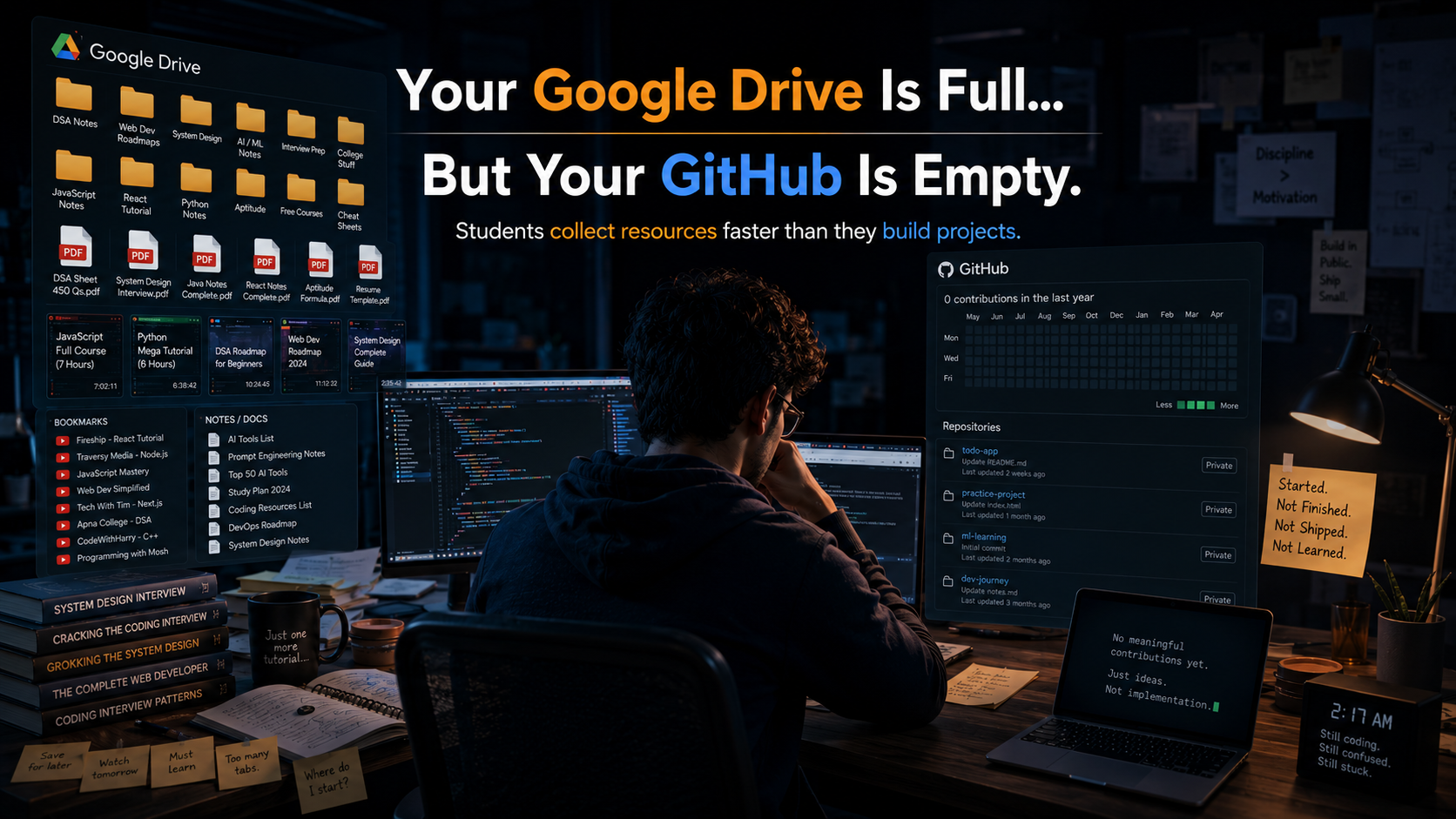
Let me describe someone to you.
You have sixteen folders on your Google Drive. One is labeled "Python Resources." Inside, there are seven subfolders: "Beginners," "Intermediate," "Advanced," "Data Science," "DSA," "Interview Prep," and "Useful PDFs – Do Not Delete."
You have another folder called "Full Stack Roadmap 2026." You downloaded it from a LinkedIn post that promised "the only roadmap you'll ever need." You have three different versions of the same JavaScript course saved from three different Telegram channels. You have a collection of AI-generated notes that you've never opened after the first glance.
Your bookmarks bar has forty-seven links. Most of them say things like "Learn React in 30 Days" or "Complete Backend Guide" or "Coding Interview Cheatsheet 2026."
You feel busy. You feel productive. You feel like you're learning.
Here's what I need you to check.
Open your GitHub profile.
When was your last commit?
Not when you last saved a repository. Not when you last starred someone else's project. Not when you last forked something with the intention of "looking at it later."
When did you last write code, push it to a repository, and call it your own work?
I'll wait.
The Resource Collection Illusion
Here is something nobody tells you in the first year of engineering.
Collecting resources feels exactly like learning.
Your brain releases a small amount of dopamine every time you save a PDF, bookmark a tutorial, or join a Telegram channel with "free courses." It's the same neurological reward you get when you actually complete a task. Your brain cannot distinguish between the anticipation of learning and the act of learning itself.
This is not your fault. This is how your brain is wired.
But this wiring is destroying your progress.
I have watched hundreds of engineering students, BCA students, and self-taught developers fall into the exact same trap. They spend months — sometimes years — curating the perfect learning path. They collect the best tutorials. They save the most recommended roadmaps. They join every coding community.
And at the end of two years, they cannot build a simple CRUD application without following a YouTube video step by step.
Not because they are not smart enough.
Because they confused collecting with doing.
Why Students Avoid Projects (Without Admitting It)
Let me tell you something uncomfortable.
Projects feel dangerous. Tutorials feel safe.
When you watch a tutorial, you cannot fail. You are a passive observer. The code works on the screen. The instructor explains everything. You understand each line as it appears. There is no risk. There is no discomfort.
When you open a blank code editor and start a project from nothing, you can fail. You will encounter errors you don't understand. You will stare at a bug for forty-five minutes. You will feel stupid. You will question whether you are "cut out for coding."
So your brain makes a quiet calculation.
"Why feel stupid when I can just watch another tutorial?"
And then another.
And then another.
And then two years have passed.
I see this constantly with students learning Full Stack development. They watch sixteen different tutorials on React hooks. They can explain useState and useEffect in detail. They can answer interview questions about the virtual DOM. But ask them to build a simple task manager with authentication, and they freeze.
The knowledge is there. The implementation ability is not.
Because implementation is a different muscle.
And you cannot build that muscle by watching.
What Your GitHub Silence Tells Employers
Here is a reality that placement cells rarely explain.
When a technical interviewer looks at your resume, they look for two things. First, your degree and college. Second, your GitHub profile.
Not your certificate collection. Not the list of courses you completed. Not the "Python for Beginners" badge from some online platform.
Your actual code.
I have spoken to hiring managers at product companies, service-based firms, and startups. They all say the same thing. A GitHub profile with three complete projects — even imperfect ones — is worth more than ten course certificates from prestigious platforms.
Why?
Because certificates prove you consumed information.
Projects prove you can create something.
Companies do not need people who can watch tutorials. They need people who can solve problems. And problem-solving only reveals itself in the messy, uncomfortable process of building something real.
When your GitHub is empty, you are telling every potential employer one thing: "I have learned about coding, but I have not learned to code."
That is a dangerous message to send.
The Hidden Fear Behind Empty Repositories
Let me say something honest.
Most students do not build coding projects because they are afraid of being judged.
They worry their code is not clean enough. They worry someone will see their repository and think "this person doesn't know what they're doing." They want to wait until they are "good enough" to share their work.
This is backwards.
You become good enough by sharing imperfect work, getting feedback, and improving. Not by hiding until perfection arrives. Perfection never arrives.
I have seen final-year engineering students with excellent academic scores produce their first GitHub repository two weeks before placement season begins. The repository has one commit. The code is hard to read. The documentation is missing.
And they are surprised when recruiters are not impressed.
Compare this to a second-year student who started building small projects from month one. Their GitHub has twenty repositories. Some are incomplete. Some have bugs. Some were abandoned halfway. But each one shows progression. Each one shows someone who codes regularly, experiments, and learns by doing.
That second-year student will get hired faster than the final-year perfectionist.
Every single time.
What Implementation Actually Does To Your Brain
Here is something that coding tutorials cannot give you.
When you implement something yourself — when you struggle through errors, debug line by line, and finally see your code work — your brain rewires.
That feeling of "I built this" creates confidence that no amount of passive watching can produce.
I have seen this transformation hundreds of times with students learning practical coding skills. The first project is painful. The second project is slightly less painful. By the fifth project, something shifts. They stop fearing the blank screen. They start believing they can figure things out.
That belief is what separates beginner developers from job-ready developers.
Not intelligence.
Not memory.
Not the number of tutorials completed.
Implementation confidence.
And you can only get it one way.
By implementing.
The AI Problem Nobody Is Talking About
We need to have an honest conversation about AI tools.
ChatGPT, GitHub Copilot, and every AI assistant are extraordinary. They make developers faster. They help debug complex issues. They explain concepts clearly. I use them. Every working developer I know uses them.
But there is a hidden danger for students.
Students are using AI to skip the struggle.
I see students copying AI-generated code without understanding it. I see students pasting error messages into ChatGPT and implementing the solution without knowing why it works. I see students treating AI as a replacement for thinking, not as a tool to enhance thinking.
This creates a terrible outcome.
Students feel productive. They complete assignments faster. They get working code immediately.
But they are not learning.
When the AI is not available — during a technical interview, a whiteboard coding round, or a live coding assessment — they freeze. They never built the muscle of independent problem-solving. The AI was doing that work silently.
Let me be clear.
AI tools are not bad. Using them is not cheating. But using them to avoid the discomfort of learning is a trap.
The best approach I have seen among students who genuinely grow is this:
Struggle first. Debug yourself. Try to solve it alone. Then use AI to understand what you missed.
Not the other way around.
What Actually Creates Industry-Ready Developers
After watching hundreds of engineering students go through the learning process, I have noticed a clear pattern.
The ones who become industry-ready — the ones who get placed, build real software development skills, and grow into confident developers — all do the same few things.
First, they stop collecting resources after the first month. They pick one path and stick to it. They do not chase every new trend or roadmap.
Second, they build something small every week. Even if it is ugly. Even if it is simple. Even if it already exists. The act of building is what matters.
Third, they accept that confusion is normal. They do not panic when they do not understand something. They debug, search, ask questions, and keep moving.
Fourth, they share their work early. They put imperfect code on GitHub. They write about what they learned. They stop waiting for permission to be seen as a developer.
Fifth, they find accountability. This could be a study group, a mentor, or a structured learning environment. But they do not isolate themselves with tutorials and hope for the best.
These five habits produce developers.
Not certificates. Not roadmaps. Not endless collections of saved resources.
A Quiet Truth About Mentorship
I want to say something that might sound obvious but needs to be said.
Most students already know they should build projects. They already know coding tutorials are not enough. They already know their GitHub should have activity.
Knowing is not the problem.
The problem is doing it alone.
When you sit in your room with an empty code editor and no one to ask for help, the resistance is enormous. Every error feels like a wall. Every bug feels like proof that you are not good enough. It is easy to close the laptop and watch another tutorial instead.
This is why structured environments work.
At PrudentCAMPUS in Chhatrapati Sambhajinagar (Aurangabad), one of the things we focus on is breaking this exact pattern. Not through motivation. Not through fancy promises. Through daily implementation learning, project work, and having someone to ask when you are stuck.
You would be surprised how much faster you learn when "I don't understand this" is met with an explanation instead of a Google search spiral.
That is not an advertisement. That is an observation from watching hundreds of students go through the same transformation.
Implementation is hard alone.
It is easier with guidance.
That is simply true.
A Simple Test For Where You Are
Here is a test you can take right now.
Close all your tabs. Close your saved resources. Close your bookmarks.
Open a code editor.
Pick one thing you have been "learning" for the past month. Build something with it. Nothing fancy. A simple to-do app. A basic calculator. A weather dashboard. Anything that works.
Do not watch a tutorial. Do not ask AI to write the code. Use documentation if you need it. Use Google search. But write every line yourself.
If you can complete this in a few hours without giving up, you are on the right track.
If you stare at the blank screen and realize you have no idea where to start, you have been collecting resources instead of learning.
That realization is uncomfortable. But it is also the most useful thing you will feel all week.
Because now you know what the real problem is.
And knowing the problem is the first step toward fixing it.
What To Do Next
I am not going to tell you to delete your Google Drive folders. Keep them. Some of those resources are genuinely useful.
But stop adding new ones until you have implemented what you already have.
Pick one language. One framework. One stack. Build ten small projects. Not perfect projects. Finished projects.
Put them on GitHub. Write bad README files. Improve them later.
Make your first commit today. Not tomorrow. Not next week. Today.
The student who starts building now will be ahead of the student who watches one more tutorial.
Always.
And if you are in Aurangabad or Chhatrapati Sambhajinagar and you want a learning environment that prioritizes implementation over information, there are places doing that work. PrudentCAMPUS is one of them. Not because it is special. Because it focuses on the thing that actually works.
Building.
Not collecting.
That is the only difference that matters.
Your Google Drive is full.
Now go fill your GitHub.
🚀 Stop Collecting. Start Building.
Get structured guidance, daily implementation, and mentor support:
Frequently Asked Questions
Why do students collect resources but never build projects?
Collecting resources triggers a dopamine reward that feels like learning. The brain can't easily distinguish between the anticipation of learning and the act of learning itself. This creates an illusion of progress without actual skill development. The only fix is to stop collecting and start building — even if the first project is messy.
How many GitHub projects do I need to get placed?
Three to five complete, working projects are enough — even if they're imperfect. What matters more is that you built them yourself, can explain your code, and show progression over time. A single well-documented project is better than ten repositories with one commit each.
Can AI tools help me learn coding faster?
Yes, but only if you struggle first. Use AI to understand what you missed, not to skip the learning process. Students who paste AI-generated code without understanding it never build independent problem-solving skills. The right order: struggle → debug → search → then AI as a last resort for explanation.
What's the first project a beginner should build?
A simple to-do application with basic CRUD operations (Create, Read, Update, Delete). It teaches you frontend basics, state management, and data persistence. Complete it fully before moving to anything complex. A finished simple project is better than an abandoned complex one.